
Collapse of the Petrodollar | What Happens Next?
The world economy hinges on the dollar’s stability, particularly the petrodollar system. A potential collapse of the petrodollar could profoundly reshape global financial landscapes. Understanding these implications is crucial for grasping the broader geopolitical shifts that may follow.
A Historical Overview of the Petrodollar
After World War II, the United States emerged with abundant gold reserves, prompting the creation of a new global monetary system at the Bretton Woods Conference. This system established the U.S. dollar, backed by gold, as the foundation of international trade. The dollar was perceived as “as good as gold,” making it the world’s primary reserve currency. Countries worldwide were compelled to hold dollars for international transactions or to exchange them with the U.S. for gold.
Paul Hoffman | MSN | After World War II, the United States emerged with abundant gold reserves, prompting the creation of a new global monetary system at the Bretton Woods Conference.
However, the system began to falter as U.S. spending on warfare and welfare expanded, leading to an excessive printing of dollars. The situation reached a tipping point when countries started redeeming their dollars for gold, rapidly depleting U.S. reserves. This imbalance led President Nixon to sever the dollar’s ties to gold in 1971, marking a pivotal shift in global economics.
The Emergence of the Petrodollar System
In response to these challenges, the U.S. forged a critical agreement with Saudi Arabia, laying the groundwork for the petrodollar system. This arrangement required oil transactions worldwide to be conducted in U.S. dollars, stabilizing the dollar and securing its status as the dominant reserve currency. Under this system, oil-rich countries like Saudi Arabia invested their oil revenues in U.S. Treasuries, providing the U.S. with a substantial financial buffer to manage its deficits.
This mechanism has profound implications. It creates a robust demand for the U.S. dollar because countries need it to purchase oil. This demand helps to maintain the dollar’s value and the U.S.’s economic hegemony. The petrodollar system supports the U.S. economy by enabling it to sustain large deficits without the typical consequences of currency devaluation.
The Global Impact of the Collapse of the Petrodollar
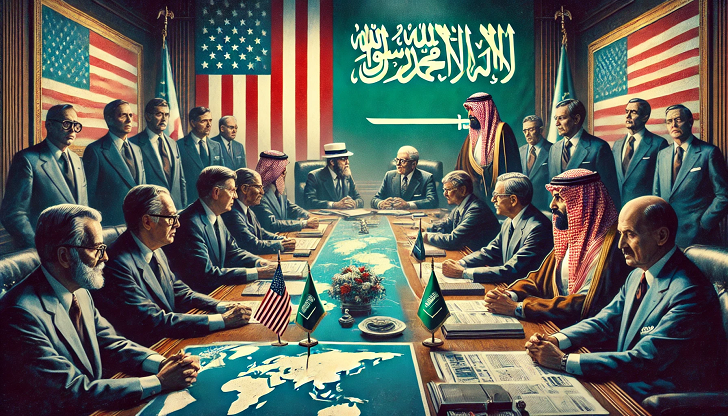
FrontStory | The U.S. forged a critical agreement with Saudi Arabia, laying the groundwork for the petrodollar system.
If the collapse of the petrodollar becomes a reality, the immediate consequence would be a significant reduction in global demand for the U.S. dollar. Countries would no longer need to hold large reserves of dollars for oil transactions, potentially leading to a rapid dollar devaluation. This shift could trigger a domino effect across the global economy, affecting everything from international trade agreements to foreign exchange rates.
Moreover, such a scenario could lead to increased geopolitical instability. Historically, the U.S. has demonstrated a willingness to use military force to protect its interests in maintaining the petrodollar system. The demise of this system could, therefore, escalate tensions, particularly with countries like Russia and China, which have been actively working to undermine the petrodollar by conducting oil transactions in alternative currencies.
Strategic Shifts in Global Energy Markets
The potential petrodollar collapse would accelerate the diversification of global energy transactions. Countries might seek more autonomy in their economic dealings by using regional or digital currencies for oil trades. This could empower oil-producing nations, giving them more leverage over their resources and economic terms.
Matt Posky | MSN | The potential petrodollar collapse would accelerate the diversification of global energy transactions.
The shift away from the petrodollar could spur innovation and adoption of alternative energy sources. As countries reassess their economic alliances and strategies, they might invest more heavily in sustainable energy technologies, reducing the overall strategic importance of oil and, by extension, the U.S. dollar in global markets.
Economic and Financial Repercussions
The economic landscape could see dramatic shifts with the decline of the dollar’s dominance. U.S. Treasuries might lose their appeal as a safe asset, leading to higher interest rates and making it more challenging for the U.S. to finance its deficits. This situation could exacerbate domestic economic issues, such as inflation and public debt levels, putting additional pressure on the U.S. government to find new ways to sustain its economic policies without the benefit of commanding the world’s primary reserve currency.
The potential collapse of the petrodollar poses significant challenges and opportunities for the global economy. It signals a possible end to the dollar-centric world economic order, paving the way for a more diversified and equitable global economic system. However, the transition could be fraught with economic turmoil and geopolitical tension, underscoring the need for careful navigation and robust international cooperation in the years ahead.
More in Business
-
`
 Why the Rich and Famous Are Selling Their Ski Mansions in Secret
A quiet layer of Colorado’s ski-home market rarely shows up on public real estate platforms. Behind the scenes, multi-million-dollar mansions change...
April 25, 2026 -
`
 What’s the Average Investment Portfolio for People in Their 30s Today?
Reaching the 30s often brings a mix of financial priorities that compete for attention. Home ownership, student loan repayment, growing families,...
April 19, 2026 -
`
 Is Tesla’s Investment in xAI a Smart Move for Investors?
Tesla’s decision to invest nearly $2 billion in xAI has quickly sparked debate across Wall Street. At first, the move may...
April 12, 2026 -
`
 If You Owe Student Loans, Don’t Miss This Treasury Update
A major shift is on the horizon for millions of student loan borrowers across the United States. The federal government has...
April 5, 2026 -
`
 Is $1 Million the New Middle Class? Why Millionaires Don’t Feel Rich Anymore
Reaching a million dollars once symbolized success. Today, it feels more like a milestone than a finish line. Many who achieve...
December 21, 2025 -
`
 Switzerland Ends Hands-Off Stance With Landmark Foreign Investment Screening Law
For years, Switzerland stood out as one of the few major economies without a broad system to screen foreign takeovers. Deals...
December 21, 2025 -
`
 Cash Habits of Rich Americans and Practical Tips to Grow Your Savings
Building long-term wealth isn’t about stuffing money under a mattress. Many affluent Americans understand that sitting on large piles of idle...
December 14, 2025 -
`
 Tax Accounting is the Hottest Seasonal Job on the Market, Study
A new analysis from Monster reveals something few expected. Tax accounting is now the most in-demand seasonal job title in the...
December 13, 2025 -
`
 The Role of AI and Empathy in Modern Financial Advice
Advisers today are challenged to harness new technology without diminishing the human element that clients rely on. AI, automation, and digital...
December 7, 2025
More From InvestmentGuru
-
 Warren Buffett’s 2 Success Lessons Ndamukong Suh Still Follows
Ndamukong Suh learned about success from one of the most respected investors in the world. More than 15 years ago, while...
Rich & FamousSeptember 12, 2026 -
 Why Investing in a Single Stock Can Be a Risky Move
A stock can look like a clear winner when a company has strong products, rising profits, or an exciting future. That...
AdvisorSeptember 4, 2026 -
 Retail Investors Sell SpaceX Shares for the First Time Since IPO
SpaceX retail investors shifted direction on August 7, selling more shares than they bought for the first time since the company...
InvestmentsAugust 30, 2026 -
 Robinhood Launches $200M Fund for Y Combinator Startups
Robinhood is preparing to give retail investors access to a fund focused on startups linked to Y Combinator, one of Silicon...
BusinessAugust 22, 2026 -
 Why Korean Celebrities and Sports Stars Just Invested $70 Million in Athletics
The Athletics continue to build financial support for their move to Las Vegas, adding another group of well-known investors just days...
Rich & FamousAugust 15, 2026
You must be logged in to post a comment Login