

Why Gold Investment Is Gaining Attention Right Now
Gold has long been viewed as a store of value during uncertain economic periods. While stocks, bonds, and other assets often react sharply to market conditions, gold tends to attract attention when investors seek stability.
Current market trends have placed the precious metal back in focus, particularly as prices have pulled back, inflation remains elevated, and investment options have become more accessible.
For those evaluating portfolio diversification, recent developments have created a strong case for taking a closer look at gold. Several economic factors are converging, making this asset class worth examining.
Gold Prices Have Dropped Significantly

Magnific | Gold’s recent price decline has created a more affordable entry point for investors seeking long-term stability.
One of the biggest reasons gold is drawing interest is its recent price decline. On January 28, 2026, gold was priced at $5,589.38 per ounce. By June 17, 2026, the price had fallen to $4,344.90 per ounce.
This represents a decline of approximately 22% in less than six months.
Price corrections are not unusual in the gold market. Short-term fluctuations often occur due to changes in investor sentiment, economic data, and monetary policy expectations. However, a broader look at historical performance shows a different picture. In June 2021, gold traded at roughly $1,800 per ounce. Despite periodic declines, the long-term trend has generally moved upward.
A lower entry price naturally creates more flexibility for investors who may have previously considered gold too expensive. At the same time, financial experts often suggest maintaining balance within an investment portfolio. Many recommend limiting gold exposure to no more than 10% of total investments so that other asset classes can continue contributing to long-term growth.
More Investment Choices Are Available
When gold prices exceeded $5,000 per ounce, investors often had fewer practical entry points. Smaller purchases, such as fractional gold coins and bars, became popular because they required less upfront capital.
With prices now considerably lower, a wider range of options has become accessible.
Investors may find full one-ounce gold bars and coins more attainable than they were earlier this year. In addition, investment vehicles linked to gold have become easier to consider from a cost perspective. These include Gold IRAs and gold exchange-traded funds (ETFs).
Each option comes with distinct characteristics. Physical gold offers direct ownership, while Gold IRAs provide retirement-focused exposure. Gold ETFs, meanwhile, allow investors to participate in price movements without storing physical metal.
The availability of multiple entry points gives investors greater flexibility to choose an approach that aligns with their financial objectives and risk tolerance.
Rising Inflation Strengthens Gold’s Appeal
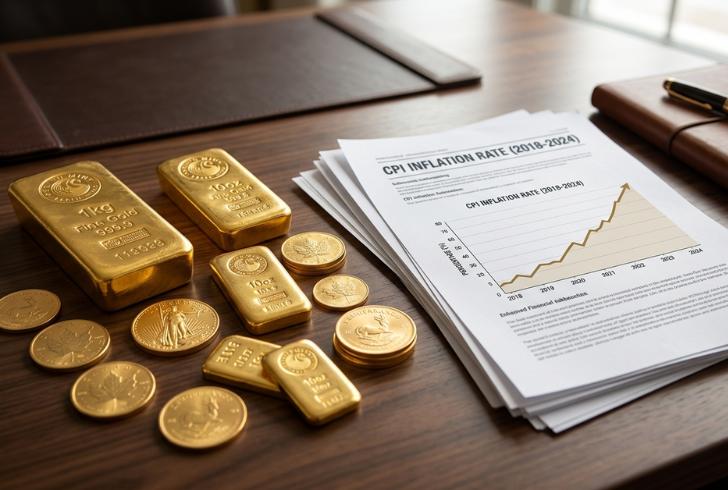
Gemini AI | Persistent inflation continues to drive investor interest in gold as a way to protect long-term purchasing power.
Inflation continues to play a major role in investment decisions. At 4.2%, inflation has reached its highest level since April 2023. The figure also sits more than two percentage points above the Federal Reserve’s long-term target of 2%.
As a result, expectations for near-term interest rate cuts have weakened considerably.
Periods of elevated inflation often increase interest in assets that can help preserve purchasing power. Gold has historically been viewed as one such asset. Unlike cash, which can lose value as prices rise, gold has often maintained its worth during inflationary cycles.
Recent years have provided several examples of gold’s resilience. During times of economic pressure and rising consumer prices, the metal has frequently retained value and, in some cases, appreciated.
Because inflation tends to move in cycles, some investors view gold as a long-term portfolio component rather than a short-term trade. Its role is often tied to risk management and protection against future economic uncertainty.
Gold continues to attract attention as market conditions shift. The recent drop in price from January levels has improved affordability, while expanded investment options have made entry easier across different formats. Inflation at 4.2%, the highest in over three years, has also strengthened interest in assets that help protect purchasing power.
Even so, portfolio balance plays a key role. Limited exposure to gold can offer stability benefits without reducing the growth potential of equities and bonds. Under current economic conditions, gold is once again being evaluated as a practical diversification tool.
More in Investments
-
`
 Why the Ultra-Wealthy Are Investing Outside the US
The United States still holds its position as the world’s largest center for billionaire and millionaire wealth. Yet a noticeable shift...
May 17, 2026 -
`
 SpaceX Is Going Public — Here’s What $5,000 Could Become in 5 Years
Anticipation is building around one of the most closely watched public offerings in recent memory. SpaceX, led by Elon Musk, has...
May 10, 2026 -
`
 Reed Hastings, Netflix Co-Founder, Is Leaving the Company
Netflix confirmed in its first-quarter earnings report that Hastings will not seek reelection to the board and will officially part ways...
May 1, 2026 -
`
 Why the Rich and Famous Are Selling Their Ski Mansions in Secret
A quiet layer of Colorado’s ski-home market rarely shows up on public real estate platforms. Behind the scenes, multi-million-dollar mansions change...
April 25, 2026 -
`
 What’s the Average Investment Portfolio for People in Their 30s Today?
Reaching the 30s often brings a mix of financial priorities that compete for attention. Home ownership, student loan repayment, growing families,...
April 19, 2026 -
`
 Is Tesla’s Investment in xAI a Smart Move for Investors?
Tesla’s decision to invest nearly $2 billion in xAI has quickly sparked debate across Wall Street. At first, the move may...
April 12, 2026 -
`
 If You Owe Student Loans, Don’t Miss This Treasury Update
A major shift is on the horizon for millions of student loan borrowers across the United States. The federal government has...
April 5, 2026 -
`
 Is $1 Million the New Middle Class? Why Millionaires Don’t Feel Rich Anymore
Reaching a million dollars once symbolized success. Today, it feels more like a milestone than a finish line. Many who achieve...
December 21, 2025 -
`
 Switzerland Ends Hands-Off Stance With Landmark Foreign Investment Screening Law
For years, Switzerland stood out as one of the few major economies without a broad system to screen foreign takeovers. Deals...
December 21, 2025
More From InvestmentGuru
-
 Nick Clegg’s Nscale Stake Could Be Worth $40 Million After IPO
Nick Clegg could see the value of his stake in UK-based data center company Nscale rise sharply if the company completes...
Rich & FamousOctober 10, 2026 -
 Where Does the Money Go When the Stock Market Crashes?
A sharp stock market drop can erase trillions of dollars in market value within hours. That can make it seem as...
AdvisorOctober 3, 2026 -
 How to Protect Your Portfolio During Market Volatility
Market swings can test even the most carefully planned investment strategy. A sudden drop can trigger fear, while a sharp rise...
InvestmentsSeptember 26, 2026 -
 Why Nvidia Is Spending Nearly $13 Billion on Hugging Face
Nvidia is making a major move in the artificial intelligence software market. The chipmaker plans to acquire AI platform Hugging Face...
BusinessSeptember 19, 2026 -
 Warren Buffett’s 2 Success Lessons Ndamukong Suh Still Follows
Ndamukong Suh learned about success from one of the most respected investors in the world. More than 15 years ago, while...
Rich & FamousSeptember 12, 2026
You must be logged in to post a comment Login